
My approach to the Pro Mom Project (PMP) scheduling method cannot be separated from my academic and professional background. I’m an engineer and technical manager with an undergraduate degree in Mechanical Engineering and a master’s degree in Engineering Management. I’ve spent the last 11+ years sharpening a unique propensity for solving problems through systematic, logical approaches. And if you can indulge me in some nerdy mathematical references, I’ll walk you through a simple example of the mathematical concepts associated with Science, Technology, Engineering, and Mathematics (STEM) can effectively be applied to the complex scheduling challenges of working parenthood.
When I was pondering how to develop and optimize my schedule with the introduction of my second child, I considered the major variables that drive a schedule’s activities. It reminded me of the concept of “functions,” used throughout many math and engineering applications. I’ll give a quick overview below.
When creating a graphical representation, the line that is created is a function of its variables. You may remember back to middle school math, you learned that the equation for a line is y=mx+b, where m and b are constants. For example, the equation y=2x+4 defines a line where the slope rises by 2 units in height for every 1 unit in length, and the line meets the y-axis at a height of 4 units. x is the variable that is used to calculate the y value at any given point on the line. x is the input which determines the output of y. This means that y is a function of x. Another common way to write the equation of the line would be to replace y with f(x); so f(x) = 2x+4. f(x) means that that the equation is a function of the variable x.
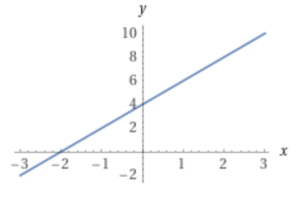
Okay, back to determining the best way to optimize a schedule. I asked myself what is a schedule a function of? For me and many working parents, a schedule is a function of many different things that could be broadly categorized into three distinct variables: Profession-related, Children-related, and Other-related activities. In other words, the schedule S is a function of Profession (P), Children (C), and Other (O). S = f(P,C,O).
In turn, the Professional, Children, and Other activities are functions of their own inputs:
- Professional-related activities are a function of how many hours per week you work, where you work, whether your schedule is flexible, etc.
- Children-related activities are a function of the number of children, age of the children, unique needs of the children, interests of the children, budget for childcare, etc.
- Other activities are a function of your fitness goals, sleep needs, relationship status, choices to outsource housework, religion, hobbies, pets, elder care responsibilities, etc.
By defining these inputs, we can understand the constants (or constraints as I like to think of them) and variables that drive our schedule. We can also identify where there is opportunity to optimize, or make changes toward improvement based upon our own personal goals.
For example, your Professional schedule may be constrained by the fact that you are required to work a constant 40 hours per week. However, the specific hours you work may be variable in that you can start your day anytime between 7am and 9am on weekdays. This means that when optimizing your schedule, you can look at adjusting your work start/end times on any given weekday in order to better fit other activities into your life, but you can’t look at reducing your work hours altogether without taking a financial hit.
While the above example may seem simple, it becomes difficult to identify all areas of flexibility, constraint, or opportunity to complete tasks simultaneously when attempting to balance an overwhelming number of activities in a given week. This is where the PMP process comes in, with editable digital tools already available for you to define your personal goals and build/optimize their schedule to meet those personal goals. And once you have completed the process, you can easily transfer the data from your optimized schedule to your planning tools of choice, whether it be a physical or digital calendar system.
Let me know in the comments, what areas of your schedule do you find hardest to balance? I would love to connect and help you find innovative solutions.
 Pro Mom Project
Leave a comment